
By Graham Fry, International Welding Engineer
Most asset owners think compliance arrives in the manufacturer’s data record (MDR).
It doesn’t. It arrives in the actual product and the welding. The MDR is somebody’s account of how those welds were made, and ‘an account’ is only as good as the person who compiled it.
In June, an industry body’s CEO said Australia has “a dangerous habit of assuming compliance rather than verifying it”. On that, I agree. Their 2026 Industry and Workforce Outlook Survey found 71.4% of respondents believe imported fabricated products fail to meet the relevant standards at least sometimes. It’s a survey of local fabricators, so treat it as a signal, not proof. But it tells you plenty of people don’t trust what’s arriving, and the answer is the same as it is for local work. Check it.
Where I differ is on the fix. The proposal on the table is a National Fabrication Authority. I understand the intent. But a national authority takes years to legislate, fund and staff, and without competent people on shop floors it ends up checking paper. Separately, the Productivity Commission’s interim report on fabricated structural steel found the conditions for safeguards haven’t been met.
Either way, your steel arrives next month.
You don’t need a new authority to verify a fabricator. The standards and specifications already give the asset owner the tools. Most owners just haven’t been shown how to use them.
Failure doesn’t carry a passport
In October 2020 a roof structure under construction at Curtin University collapsed. A 23 year old apprentice carpenter was killed. WorkSafe WA later charged the Australian company that fabricated the steel, along with the roof designer.
In 2017 the Matagarup Bridge arches were fabricated in Malaysia, with quality oversight reportedly on site. The arches still ran nine months late, the subcontract was terminated, and the work came back to WA.
Neither was about where the shipping container was packed. Both are reminders that what matters is whether someone competent checked the work while it could still be fixed.
Wuxi or Wingfield, the verification is the same.
Eight checks that do the job, before the first arc
1. Make sure the construction category is set
AS 4100:2020 sends most fabrication requirements to AS/NZS 5131, and choosing the construction category is the designer’s call. If the specification is silent, 5131 defaults to CC2. Being silent isn’t a decision. Inspection extent, personnel and traceability all key off that category, so ask your designer which one applies and get it on the drawing. Without clarity over what is expected you are asking for trouble.
2. Get the ITP before fabrication starts, not the MDR after it finishes
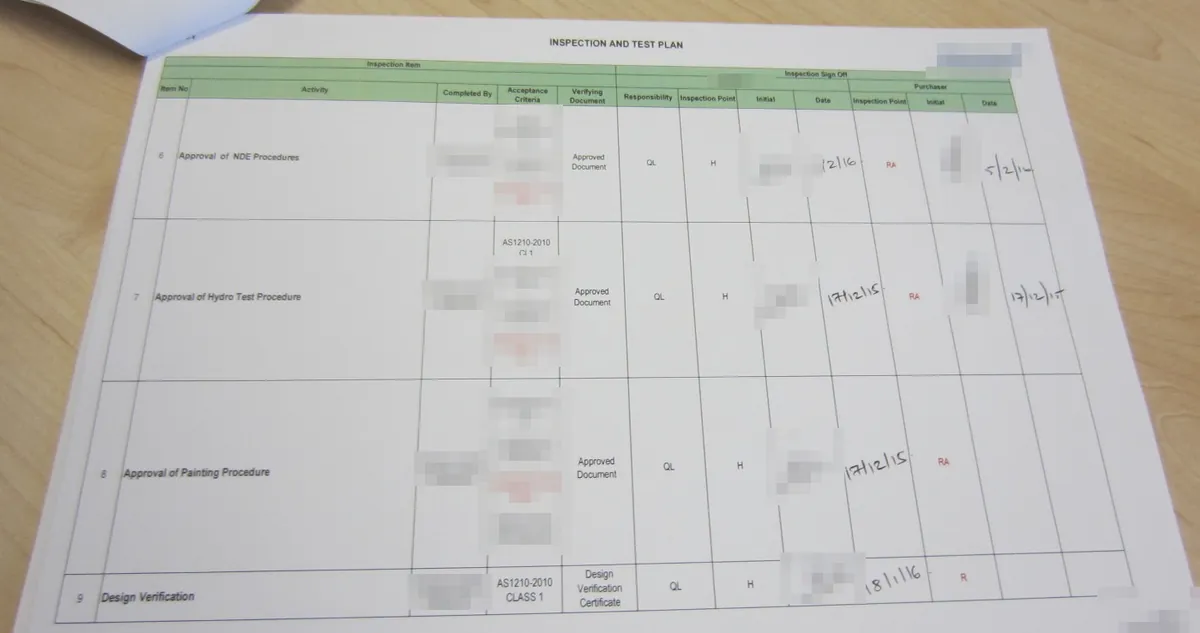
The inspection and test plan is the fabricator telling you in advance what gets checked, against what criteria, by whom, and where you get to stop the job. It provides you with the opportunity to insert where you want to check. AS/NZS 5131 sets out the welding inspection items, and Austroads ATS 5410-23, which Transport for NSW adopts, calls for an ITP that covers them. Put your hold points on it. A hold point means work stops until you sign. A witness point means you’re told, and you can turn up.
3. Check the WPS actually covers the joints
AS/NZS 1554.1 requires every weld to be made to a prequalified or qualified procedure, by a qualified welder, under a welding supervisor. The quality of the WPSs is indicative of the extent of understanding the supplier has. The usual failure isn’t a missing WPS. It’s a WPS from another job, out of range on thickness, position or material, sitting in the MDR looking official. Ask for the weld map with a WPS number against every joint.
4. Check the welders are current, not just qualified
A qualification card says someone passed a test on a given day. That’s all it says. For welders qualified to ISO 9606-1 or AS/NZS 2980, the person responsible for welding confirms each welder every six months. For AS/NZS 1554.1 qualifications, ask for the evidence of continuity. If every confirmation is dated the week you placed the order, you’ve learnt something.
5. Find out who the ‘key welding person’, the welding supervisor, is
Then ring them. Ten minutes on the phone tells you more than any certificate. AS/NZS 1554.1 requires a supervisor and ISO 3834 requires welding coordination. SA’s Department for Infrastructure and Transport goes further on its structural steel specification: the inspector is independent, and the supervisor and inspector can’t be the same person. Don’t check the paper, check the person.
6. Trace the steel
Heat number on the plate, heat number on the EN 10204 3.1 certificate, same number, right grade.
7. Know who engaged the NDT
Most NDT is engaged by the fabricator. That’s normal and usually fine. For CC3 work or fracture critical welds, engage one yourself to audit a sample. This reduces the likelihood of things getting missed. Confirm the extent matches the construction category, the operator is certified for the method, and the lab holds NATA accreditation, or the ILAC equivalent for a lab overseas. Ask for the technique sheet, not just the word PASS.
8. Go and look, this is the most important step
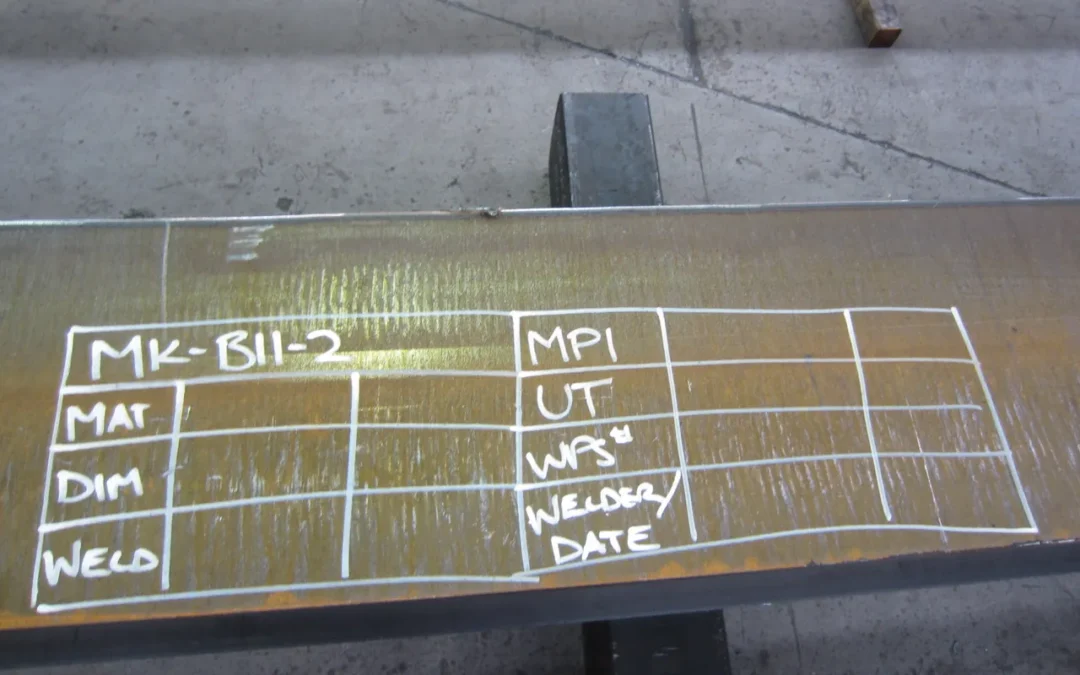
This tells you the level of controls you need to put in place. Walk the floor at the beginning, observe how they operate, no point doing it at the end, at final inspection when everything’s painted.
Scale it, put it in the contract, and know what to do when a check fails
Not every job needs all eight at full depth. A CC1 handrail package might need checks 3, 4 and 6 done on paper in an hour. A CC3 bridge girder needs all eight, an independent inspector at the hold points, and NDT you engage yourself.
Ensure you have a kick off meeting, put the ITP, hold points, right of access and the records format in the purchase order. Before award it’s a condition. After award, you’re asking.
And when a check fails, don’t reject the job. Raise it, hold that piece of work, and ask for the evidence. A shop that’s in control sorts it in days.
If you don’t have someone in house to do this, that’s fine. Competent means a welding supervisor qualified to AS 2214, a welding inspector, an IWS, IWT or IWE, and NDT personnel certified to ISO 9712 for the testing.
The ‘same pen’ test
Here’s a test I use on every MDR. Look at the ITP signatures. If every hold point on a twelve week job is signed on the same day, in the same pen, by the same hand, the inspection probably didn’t happen at the hold points. It happened at the photocopier, just before you got there. Sometimes there’s an honest reason, records get transcribed into a clean copy. Ask for the originals.
A few more that tell you to dig deeper. Welder IDs on the NDT reports that aren’t on the welder register. A mill cert where the grade on the paper isn’t the grade on the plate. An NDT report that says acceptable with no acceptance standard, no technique and no extent. A WPS claiming all positions and unlimited thickness off one PQR.
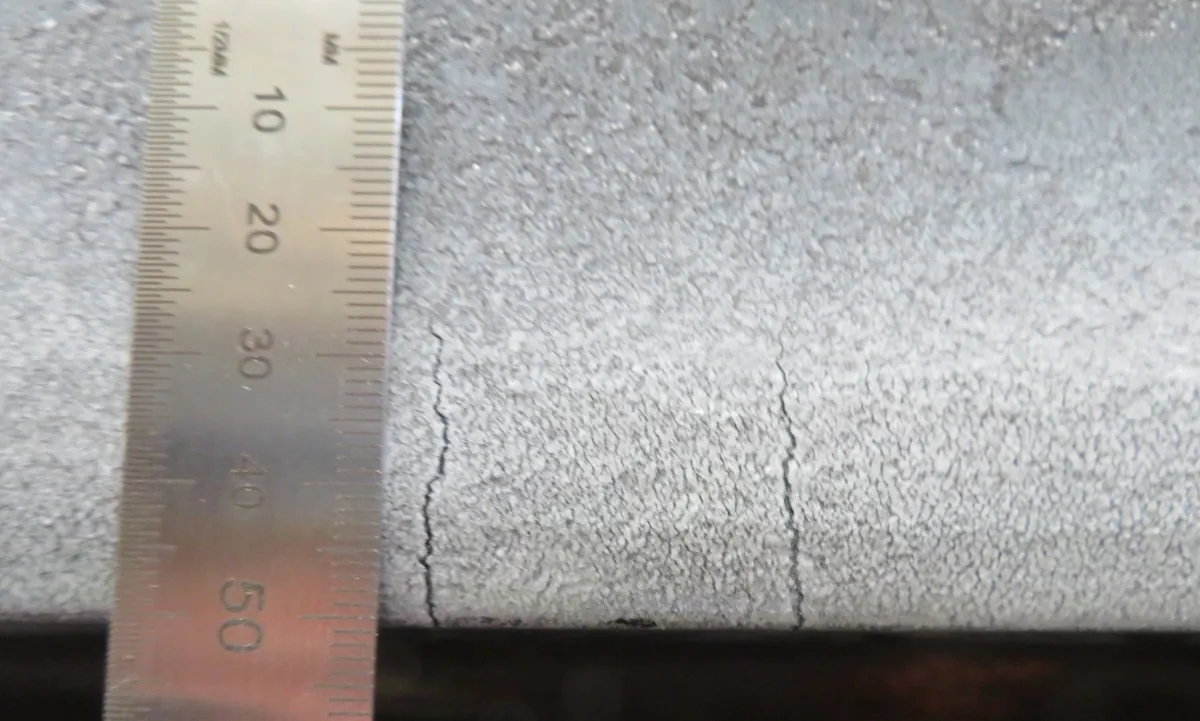
None of these takes an engineering degree to spot. It takes someone on the owner’s side who knows what good looks like, is prepared to ask and knows what a credible answer sounds like.
Good shops should want this
If you run a shop that’s in control, owner verification is on your side. It’s what stops you being undercut by a quote that left the checks out.
When every job, local or imported, gets the same ITP, the same hold points and the same heat number trace, you get compared on what you deliver, not on what an MDR claims. Clear hold points up front also mean fewer arguments at the end, fewer late NCRs and faster sign off.
And if your paperwork isn’t there yet, fix it before the client asks. Most of it is a few days work with the right person, not a new system.
Competence, not paperwork
The fabricator owns the quality. The owner owns the verification, the risk and the decision to accept it. AS/NZS 5131 gives you the right to set hold points and verify, and WHS law puts duties on everyone in the chain, including whoever commissions the work.
A new authority won’t change that. A certificate on the wall won’t either. What changes it is a competent person checking the work while it can still be fixed.
An MDR tells you what someone ‘says’ happened. Verification tells you what did.
Technoweld reviews ITPs, WPS packages and MDRs for asset owners and head contractors, and helps fabricators get theirs right before the client asks.