
Welder Qualification Testing
Contact us for a quoteTechnoweld qualifies welders to AS/NZS 1554, AS/NZS 2980, ISO 9606-1, AWS D1.1, AS 3992 and ASME IX for fabricators across Australia. We help you select the standard and coupons, witness the test at your workshop, at Wingfield in Adelaide or remotely, arrange the testing and issue the certificates under NATA accreditation. Your welders end up qualified for the work they actually do, with the fewest coupons.
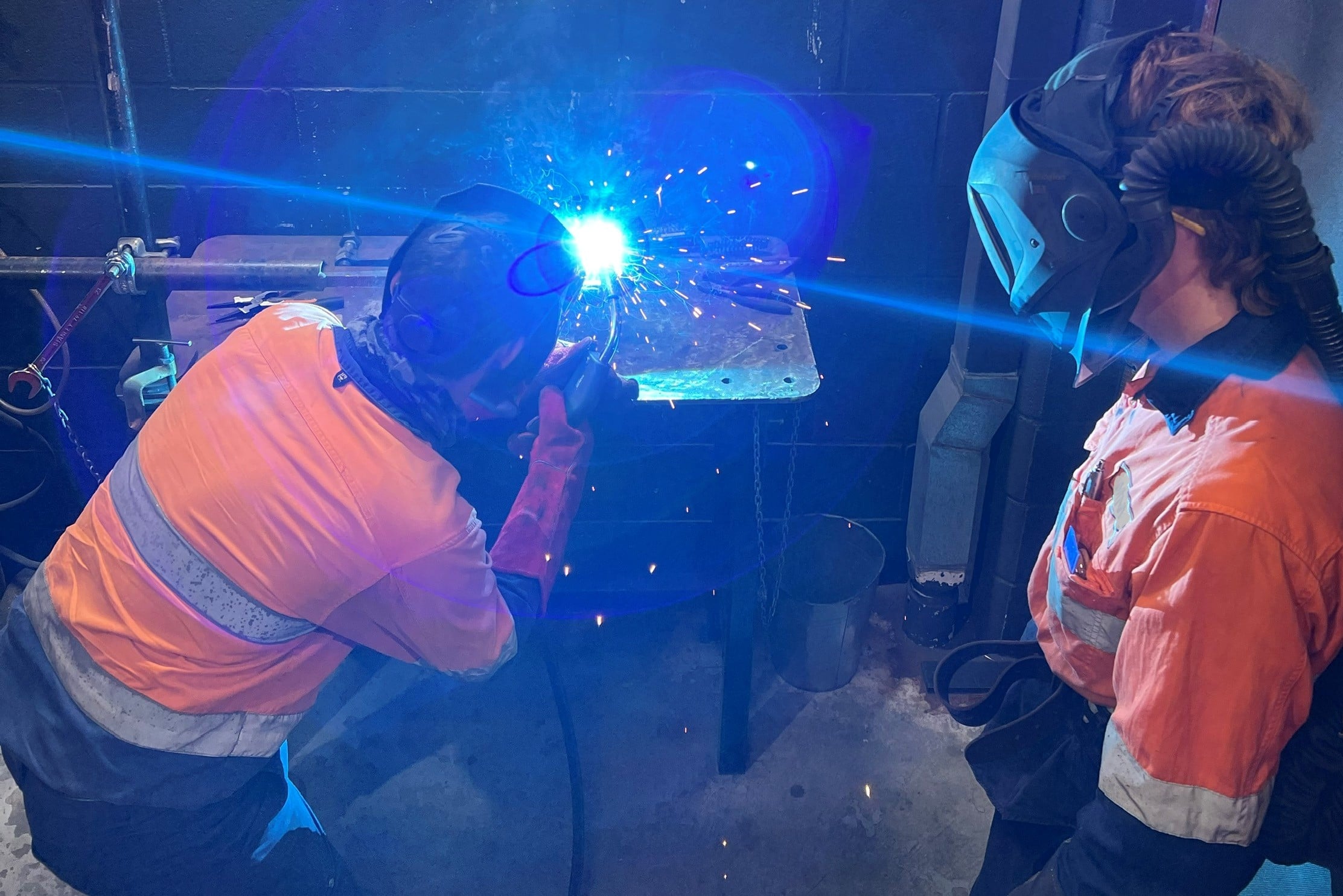
Choose the standard before anyone strikes an arc
The right standard depends on the work, the construction category and how long you want the qualification to last.
AS/NZS 1554.1. A test piece welded to the job’s procedure, at least 300 mm long, examined visually and by macro (cl 4.12.2.3). Quick and cheap, but it stays with the employer: a welder who changes employer has to be requalified by the new one (cl 4.12.2.4).
AS/NZS 2980 and AS/NZS ISO 9606-1. Qualification by process, filler material group, weld type, position, thickness and diameter, and it isn’t lost when the welder changes employer. AS/NZS 5131 requires one of these two for construction categories CC3 and CC4 (cl 7.4.2), and under AS/NZS 1554.1 a welder qualified to either, or to AS 1796 or AS 3992, is deemed qualified (cl 4.12.2.2).
AS 3992. Welders on pressure equipment and piping built to AS 1210 and AS 4041.
ASME IX. Welders on ASME VIII vessels, API 650 tanks and ASME B31.3 piping.
The most range from the fewest coupons
Every coupon costs welder time, steel and testing. A test on the harder position, joint or thickness also qualifies the welder for the conditions that are easier to weld, so the right choice of coupons can cover most of a shop’s work in one or two tests. Every standard has a different range. We set the test up that way before anyone welds.
How a test runs
- We review your WPSs and the work the welders will do, and choose the standard, the coupons and the test positions.
- Each welder welds the coupon to the WPS while our inspector witnesses it, at your workshop, at Wingfield or remotely.
- The coupon is examined visually on the day.
- Coupons that pass go for the NDT or destructive tests the standard requires, such as radiography, bend, macro or fracture tests, through our testing partners.
- Certificates are issued once the results are in.
Keeping the qualification current
A certificate doesn’t prove someone can still weld. That’s why every standard ties it to continued work.
Under ISO 9606-1 the person responsible for welding activities confirms every six months that the welder has worked within the range (cl 9.2). Revalidation follows one of three routes, chosen and stated on the certificate when it’s issued: retest every three years, test two production welds every two years, or keep it valid with the same manufacturer under a verified ISO 3834-2 or ISO 3834-3 quality system (cl 9.1 and 9.3).
AS/NZS 1554.1 requires reapproval after six months or more off the process (cl 4.12.2.4). Under ASME IX the qualification lapses after six months without using the process (QW-322.1).
We’ll pick the revalidation route that suits how your shop runs and keep your welder qualification register up to date.
What you get
- A certificate for each welder and test, stating the standard, the essential variables, the range of qualification and the revalidation route
- The visual, NDT and destructive test reports behind it
- Witnessing under our NATA accreditation as a Type A inspection body (No. 19221)
- Your welder qualification register updated
Where we test
At your workshop, at our facility at Wingfield, South Australia, or witnessed remotely. We qualify welders for fabricators in South Australia, around Australia and overseas.
Questions clients ask
How long does a welder qualification take?
The welding and visual examination happen on the day. It depends on how well organised you are and how confident the welder is. Test results and certificates normally follow in 3 to 5 business days, and we can turn them around the same day when it’s urgent.
Which standard should our welders be qualified to?
The one your contract and construction category call for. For AS/NZS 5131 CC3 and CC4 work it has to be AS/NZS 2980 or AS/NZS ISO 9606-1. Where there’s a choice, those two usually give more coverage and less upkeep than an AS/NZS 1554 test.
Does the qualification follow the welder to a new employer?
An AS/NZS 1554.1 test doesn’t: the new employer has to requalify the welder (cl 4.12.2.4). AS/NZS 2980 and ISO 9606-1 qualifications are exempt from that, unless the ISO 9606-1 certificate was issued on the revalidation route that ties it to the manufacturer (cl 9.3 c).
How often do welders need retesting?
It depends on the standard and the revalidation route on the certificate: every three years, every two years with production weld testing, or not at all while the six-monthly confirmations continue with the same manufacturer under a verified ISO 3834-2 or ISO 3834-3 system. Six months or more off the process means reapproval under AS/NZS 1554.1, and an ASME IX qualification lapses.
Can our own welding supervisor test our welders?
Under AS/NZS 1554.1, yes, for welders under their supervision (cl 4.12.1), and AS/NZS 5131 makes the welding coordinator the examiner unless the construction specification says otherwise (cl 7.4.2). Plenty of specifications and principals ask for an independent examining body. That’s where we come in.
Can one test qualify the welder and the procedure?
Yes. ISO 9606-1 allows it, provided the test also meets the procedure qualification requirements of ISO 15614-1. Worth planning for when a new welding procedure and new welders are both needed.
Book your welders in
Tell us the standard, the processes, positions and materials, and how many welders, and we’ll quote the tests.